Tuesday, February 28, 2017

Solar eclipse

February 27

We left port in Punta Arenas on February 25th at 10pm local time. I was surprised at how punctual we were leaving port - I learned later that we were actually timing it with the high tide to make sure to have no issues leaving. We docked in Punta Arenas near downtown - a very convenient locations for us as passengers going in and out of the city. It was a much less convenient docking location for our ship - the draft of the ship could barely make it to the pier. Leaving at high tide made it much less likely for us to encounter any issues of hitting the bottom.

Upon leaving Punta Arenas we continued our journey East and soon finished navigating through the Magellan Channel. Another geeky geographical point off my list:
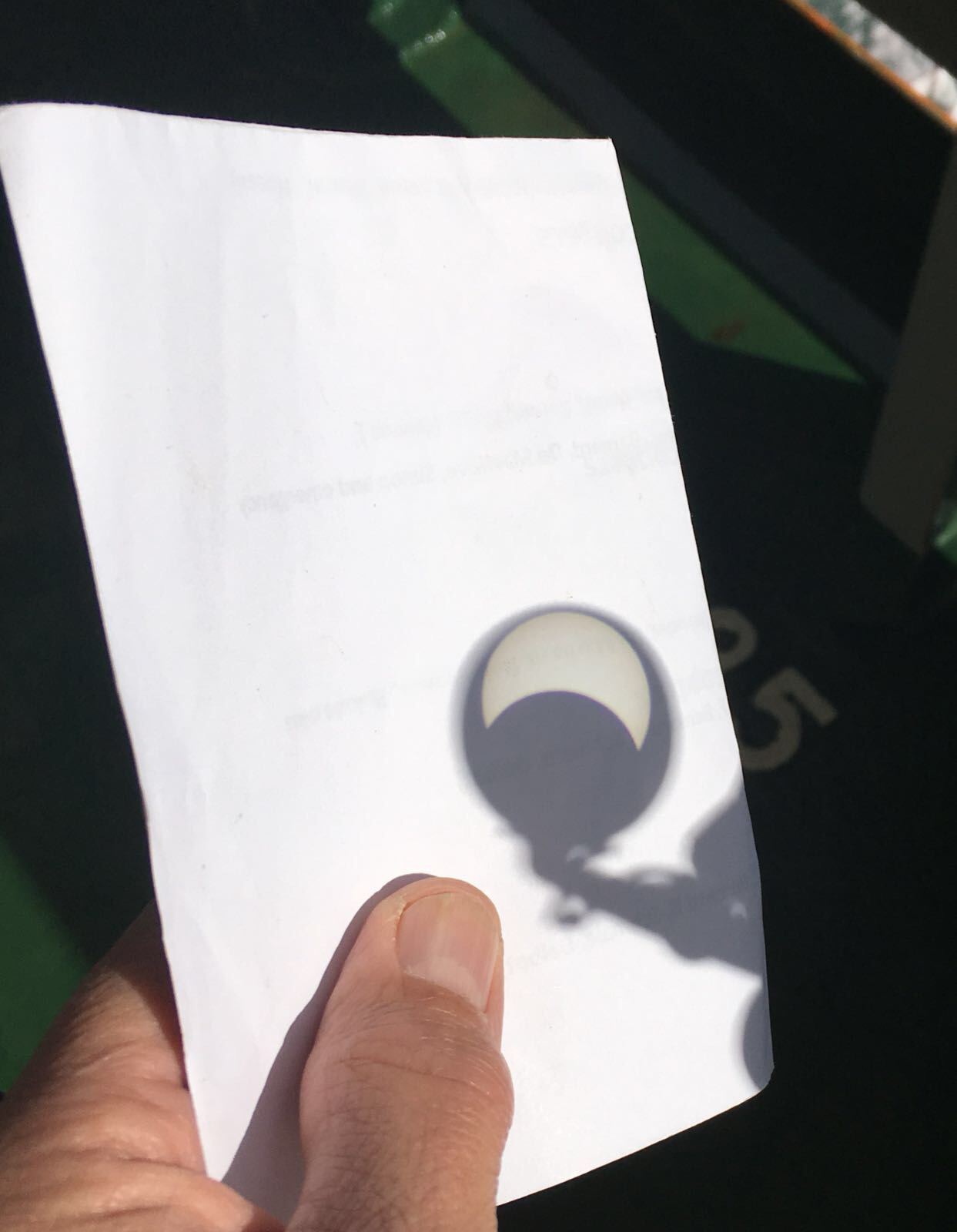
I woke up on Monday February 26th to the news that there will be a solar eclipse in half an hour and that our exact location is the best for observing it. I got up quickly and went outside. I wasn't prepared at all to observe a solar eclipse, so it was good to hang out with much more thoughtful and awake people. Bob, one of our helicopter pilots, brought his binoculars and a piece of paper
The crew came out with a welding mask, which was actually kinda cool and efficient as well
All in all I felt like with the help of my friends I got the best viewing of the solar eclipse I ever had. Thank you friends!

Saturday, February 25, 2017

Clouds near South American coast

After the smoothest crossing of the Drake passage we got into the islands of Terra del Fuego. On top of spectacular island views we got to see some amazing clouds.
First, there was a rainbow and a rather typical layer of low level stratus clouds:


Somehow it cleared up to reveal the blue sky and blue sea made its appearance as well.


The boundary between the two was rather dramatic:


Amazingly this kind of situations we later observed in Punta Arenas again. We were sitting a cafe and it was raining and gloomy on one side and clear and sunny on the other side - adjacent corner windows depicted a completely opposite view.

Coming back to our first sighting of Terra del Fuego a few days back - after dinner the clouds changed dramatically. I went outside and saw "mammatus clouds" - my first real-life mamma clouds! I only saw them in textbooks before:


These clouds are formed by powerful downdrafts, when pockets of cold (but moist) air sink down to the lower parts of the clouds. This is the reverse motion to the "usual" upward direction of convection - when warm and moist air rises.

As I write this, we have started the leg three already. I had a few days in Punta Arenas, which I used to:
~walk on land (rain or shine or both at the same time)
~touch "Terra del Fuego's foot to make sure to come back
~drive to the tip of the continent and visit Magellan park and the old (reconstructed) settlement called Fuerte Bulnes. Driving was quite interesting as I realized that after the two ports with left-side driving I was totally confused on which side of the road to use. But I figured it out quite fast and it was good to have Irina with me for safety checks every now and then. South Africa will be weird again ;)
~eat a lot of real deserts
~drink a few pisco sours that knocked me off my feet
~spent some time updating facebook - it felt so weird! It seems like a waste of time, but it was so great to connect with some of my friends.


We also collectively managed to purchase additional Helium for the radiosondes. Many thanks to Guisella, our Chilean friend from leg two and her friends. We could have not done it without you! I also want to thank Irina and Alex for giving me some time off while they went to pick up the bottles. It was so amazing to aimlessly walk around the city without a plan or a "sample alarm" to comply with. Felt weird and so-so great. It was an interesting experience, a preview of the "post-cruise" life. As we are starting the final leg of the journey I keep thinking how will it feel to be back on land. It is hard to predict really.

Anyhow, our leg three has started and I need to get some sleep. Tomorrow will be a busy day!

Thanks for reading.
Masha

Sunday, February 19, 2017

Drake Passage

February, 19 

I am writing this text in the middle of Drake Passage. Somehow this means a lot to me – I remember looking at the world map as a kid – Drake Passage was one of the first names I noticed. I guess it was one of the few titles I could actually reach and read as it was at the bottom just above Antarctica. I never thought I'd get to sail here...


We have been working really hard collecting ocean data from the Southern Ocean and now the Southern Pacific. We had on average at least one CTD station per day. This translates in collecting a lot of ocean water into small bottles, labeling and organizing them. I go up and down the stairs with boxes and bins full of bottles quite frequently now – getting new ones for the future samples and putting away the full ones into cargo containers. I get a lot of comments on my “bottle clicking sound”. I have to say that to me personally the clicking bottle sound associates with a alcoholic collecting empty bottles every the morning in order get a some money for recycling and get a small “morning” drink (опохмелиться). My colleagues tell me the sound reminds them of the milkman coming to their house every morning on milk deliveries. I like their association much better!


Working so hard made us all feel like a team, which is a good feeling. Yesterday we had a station right after dinner around 8pm and then another one at 5 am in the morning. Most of us did not sleep in between, as it was about midnight when we were done sampling, we advanced the clock again and going to bed seems like a stupid idea. After the early morning station and watching the sunrise together we all went to bed – it was funny how we were wishing each other good night around 10 o’clock in the morning.


We are much further North now, so we have real darkness once again. We were working tonight through the night again and it was pitch black. I wanted to take a picture of It, but nothing came out. Such a weird sighting after the perpetual daylight. I have to say polar days are my favorite, you can choose your own schedule and it is pretty outside all the time. I miss polar days!


We only have a few days left in leg two, we are due to arrive in Punta Arenas on February 22nd. With the cruise report due and some repacking to do I am not sure how much I will be able to post to the blog. I will try to update from Punta! I am also expecting to have internet access for a couple of days, so I will be able to read comments from people (I hope there are some comments ;)))). Also recommendations on what to do in Punta Arenas are very much appreciated!


Thank you,
Masha

Friday, February 17, 2017

Peter the 1st

February,17

On Wednesday February 15 we arrived at Peter the 1st island. It is located at roughly 90 degrees west - which marks about 70% of the longitudinal journey we have to complete during all three legs. Longitude-wise leg 2 is the most intense and it is also the longest. Ship lag is definitely upon us all...

When we first got the sea ice maps for Peter the 1st island it looked unapproachable. We almost ditched it completely from the program, but the sea ice seemed less intense later and we decided to try. We got into heavy sea ice late morning on the 15th and woke up many seals resting on ice floes:
I have never seen so many seals at the same time, I was taking pictures and videos and I couldn't get enough. I guess they did not expect us at all!

The views of the island were memorizing:
There were all forms of ice all around us - sea ice, iceberg, glaciers, etc. Even though we did not have much time to spare, we decided to use this opportunity to visit the island and collect some samples: drill an ice core, collect biological and geological samples from the beaches and collected some sea ice for the biological analyses. Helicopters and Zodiacs once again were busy for a quite a few hours delivering multiple parties to different locations, which provided good news from our upper deck "office balcony":

Wednesday, February 15, 2017

Launchings radiosondes

February 15

We had a few really busy days on Tryoshnikov. We have been transecting through the Amundsen and Bellingshausen Seas, stopping for ocean stations every day. We have also been sampling underway and launching XBTs into the ocean. At the same time we were launching quite a few radiosondes into the atmosphere to study the precursors of the atmospheric river conditions.

As a result, Irina and I have been working quite a lot and I did not have time to update my blog for a couple of days. But I also got a few pictures of me working (thanks to Irina and other colleagues, who I gave my phone to take pictures). So here’s a collage of me preparing and then launching a radiosonde:
And here's an entry from my gradnfather's journal dating back to February-March 1960 in Mirny. As I’m writing this on the first relatively “calm” day after a few non-stop work days, I can totally relate the relaxing atmosphere of life at Mirny station and I am grateful to learn how much respect he had to meteorologists launching their weather balloons in any conditions:

Жизнь в Мирном удивительно не похожа на обстановку на Востоке или на шельфе. Может такое сравнение покажется кощунством, но мне эта мирнинская жизнь напоминает санаторий (правда я никогда еще не бывал в санатории, но представляю его по-видимому правильно). Здесь, в Мирном, твердый распорядок дня - завтрак, обед и ужин, на которые исправно собираются все миряне. Четыре раза в неделю по вечерам кино, куда от нечего делать также собираются все, пару раз работает библиотека, ежедневно вызывают на обследование врачи, дежурства, несложные авралы и прочее - прочее. 

Жизнь течет размеренно и спокойно. Работают научные отряды. Ежедневно в любую погоду выходят на свои площадки метеорологи - у них 4 срока, кропят над колонками цифр синоптики - они получают сведения о погоде чёрт знает со скольких станций в Антарктике и субантарктике, дважды в день запускается радиозонд - аэрологи долго пеленгуют его потом и принимают сигналы его миниатюрного передатчика, сообщающего о температуре, давлении и влажности воздуха на разных высотах. Летит этот пузырь, с подвешенными к нему на шнурке картонным коробком, километров на 25-30 ввысь.

Monday, February 13, 2017

Science talk

February 10 (again)

On Friday February 10 Irina and I gave a talk about our project to all the scientists, guests and crew. We specifically invited several members of the crew, who have been helping us a lot during the cruise and made an open invitation to everyone through the PA system. We did an experiment talking in both English and Russian to make sure everyone in our audience could understand us.

I have to say it was rather intense – we both talked in both languages as it seems to make more sense, basically presenting each slide twice in a row: once in English and once in Russian. I presented a general introduction and an explanation to our ocean measurements.

Irina talked about the importance of the measuring snow and explained why every time it is snowing we are outside running like crazy people.


Irina also talked about our atmospheric river side project and launching radiosondes in bad weather.


We did explain the science behind all of our measurements, but I will not present the whole talk in this blogpost. In fact, I am still hoping to get more free time to finally finish a long sciency blogpost about our project that I started a while ago and can’t seem to find time to write up completely. I even promised our “official” blog writers (ACE blog) that they can publish it there… So I really need to do it soon.
But right now I just want to thank everyone who came to listen to our talk! And show our “thank you” slide as it was truly awesome:


As for continuing to write seriously about science – I have to take a rain check on that. It is 4:30 in the morning and I should go to bed now… Good night everyone and thanks for reading.

Sunday, February 12, 2017

Marie Byrd land coast

February 10

We came close to the Antarctic coast yet again during ACE. It was not necessary planed, but in cruises like this one needs to rely on the weather and sea ice conditions. We were en route to Peter the 1st island, but we learned that it is surrounded with heavy sea ice and we might not be able to get there or will have to lose valuable time getting through the ice.
Mary Byrd Land coast on the other hand was miraculously free of sea ice and the weather was nice. So we decided to do our “island” field work and ice coring on the Siple island. The Russian marine guidebook (лоция) had very limited information about the coast, suggesting that most vessels passing by encountered heavy ice conditions and never came close to the land. We were lucky.

Coming closer to the coast we encountered many beautiful icebergs.
I couldn't stop taking pictures, it was beautiful in all directions. I even felt like a tourist and asked a friend to snap a picture of me
 We also saw quite a few penguins swimming and hanging out on the ice
a few seals and some whales. I was less lucky with spotting whales, but this is just my curse this cruise, I always miss them.

Since we were in uncharted territories our helicopters went off flying and exploring the coast, while a few of us went on Zodiacs to explore nearby icebergs and see the penguins up close. What a great adventure!

Overnight we deployed ROPOS for another dive, but unfortunately this was a short dive, since the ship couldn’t be stable for a long time. Hopefully we will have more dives and get more things collected from the bottom of the ocean.